At a stage in his academic career when most journalism students are seeing their first byline printed in a collegiate newspaper, Marion's Riley Swinford (shown at right) not only has quite a portfolio of professional work to show future prospective employers, but his talents have been recognized repeatedly by a major media company. The 20 year-old graduate of Marion High School and current full-time Southern Illinois University at Carbondale sophomore moonlights 30 hours a week with the Daily Republican in Marion. A journalism major with a minor in graphic design and history, Riley began writing freelance articles for the daily newspaper's niche publications such as This Week, Healthy Living and the Mine Report four years ago while still in high school. He became an employee in July 2011 and current averages working about 30 hours a week.
Riley might have received a bit of a jump start to his career due to nepotism - his dad is the Daily Republican editor Bill Swinford - but he has also demonstrated that his dad knows talent when he sees it. The DR's parent company, GateHouse Media, has recognized Riley's design work an astounding 10 times in the last four months through the company intranet.
Riley, knowing the value of branding one's self to future employers through the Internet, agreed to be interviewed this week about his work.
What are your duties at the Daily Republican?I work 10 p.m. to 3 a.m. most nights for (a total of) 30 hours of work a week, while also attending school 15 credit hours a week. With this time schedule, I can't cover breaking news and meetings, so I focus my writing on features pieces about community members, around two to three stories a week. I paginate approximately three pages of the daily paper each night, including the front. I also manage the Daily Republican's Facebook page which has grown by 300 "likes" since I began, occasionally update the web, typeset and I also cover an occasional sporting event if I was going to attend anyway.
We'll get to your dad's influence on your career in a minute. Tell me about your mom.
My mom is Kim Swinford. She is a dental hygienist. I would say that I get my creativeness from my mom and my news sense and writing skills from my dad. My mom was an art student in high school. She also used to write a column for the DR and has also published a book. I designed the cover for the book. I am the oldest of four.
How long has your dad been at the DR?
He's worked at the Daily Republican for 12 years. He also studied at SIU and began his career for a (now extinct) GateHouse paper in Herrin in the late '80s. He also worked as a city reporter in West Frankfort for a few years when I was (age) 6 to 8. He began in composition at the DR and moved up to his current position.
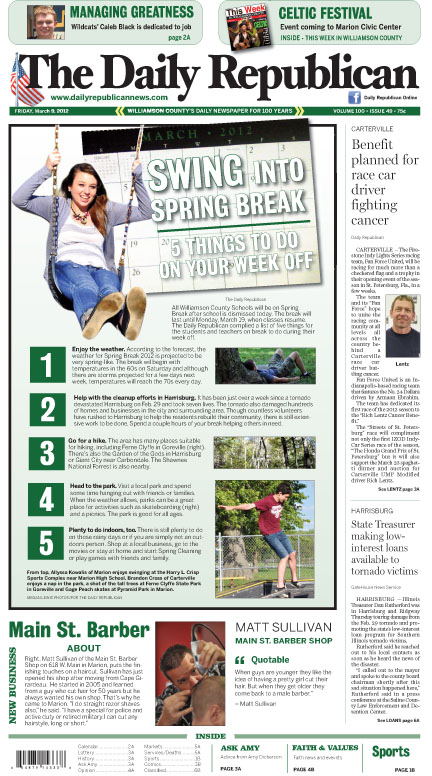
So ... your work. It has gotten a little attention lately from GateHouse. Let's quantify that ... My front pages have received front page of the day by GateHouse six times (five of these are shown at right) and they've also received special recognition for specific aspects of the page four other times. I'd also like to note that a portfolio of my work helped me earn a scholarship for next school year.
 Page design is a component of what the Society of News Design calls "visual journalism". Is that how you see yourself … as a visual journalist? Or are you a garden-variety reporter who designs pages because you were assigned the task
I think I am slowly evolving actually. I joined the newspaper class in high school because it was interesting to me because of my dad. I was a strong English student and liked to write. So at first, I did all writing. I began to play around with design software, though, and slowly changed my focus. My teacher recognized this and made the head editor at the end of my sophomore year when that job was normally reserved for seniors. I then had to focus strictly on design in that role. That was my first real taste of it. I won numerous awards at the local Southern Illinois School Press Association conference for my design, so that only encouraged me.
However, after high school, I went a long time without doing any pages. I did stringing for the paper because it was an easy way to get clippings and practice my skills. Then, once a DR reporter left to go back to school, my dad approached me about working part-time. At first, I spend about 60 percent of my time doing the everyday pages such as opinion and the weather, just plugging holes essentially. I learned the basis of the (design) programs this way and once I got self-sufficient, my dad started to assign me more and more pages to do and less writing. This freed him up to devote more hours to writing and covering events. Plus, it just made sense with how my schedule works out. I began doing the front page every so often and after GateHouse began to take notice, it became my job everyday.
Some of the smartest marketing people – think Apple's Steve jobs or entrepreneur / author Tom Peters – espouse the importance of good design to any and every product. Why do you feel it is important taking the time to make a good newspaper front page look great?

I think it's very important in today's world to have a good looking newspaper front page. The world has became so visual with the rise of the internet and I think nice looking front pages are one of the things that can get people to buy a paper. I think it's not only important to have an interesting subject, but to present it in a nice way.
I also like giving local people in this small town the feel that they are receiving "big-time" treatment in the media. For instance, if a Marion golfer wins a tournament, I like to present that in a way similar to Sports Illustrated. Also, one of the best feelings in the world for me as a designer and journalist is when I see that someone has saved a paper for their scrapbook.
Does a lot of planning go into your building front pages or is it more making the best of the art and copy you've been given?
This actually varies from day-to-day. On a day when there's a lot of hard news such as an election, important meeting or a death, there's only so many different ways you can display this. The design has to meet the tone. But on days when there's not much going on and we are going to do a feature, I sometimes talk to Tom Kane (our photographer/reporter) about a picture or graphic I'd like to use with it. One example of this was earlier this year when we did a story about budget cuts in Marion schools. I told Tom to take a picture of a meat cleaver slicing a piece of paper. This won Front Page of the Day.
What do you feel the elements of a strong front page are?
I think the best front pages include lots of faces. Moms are going to buy a paper if they see their kid on the front. People still like to see themselves in the paper.
I think the quality of the art really drives the front page. We also like to do skyboxes that show what's inside the paper. I think those are important to have so that people looking at a paper while it's in a newsstand can know if there's topics that interest them inside.
 Lastly, I also think that it's key to include the most relevant stories. With the time that our paper actually comes out and hits newsstands, the important national stories have already been read online or in the morning editions from other papers. I think it's key to make a front page that fits the readership and region and isn't strictly based on national trends. I think this is important for all small town papers to realize going forward.
Actor Alan Ladd is credited with saying, "Not every father gets a chance to start his son off in his own footsteps." At what point did you become attracted to your dad's career and why? Did he try to steer you toward or away from the profession?
Honestly, this really happened by accident. Growing up, I spend a lot of evenings with my dad at events or the office. He wasn't necessarily trying to show me the ropes, he just had to babysit. While I would hang with him, I would play around on the computers at the office and I would even sometimes make my own little newspaper. Like I said, I signed up for journalism in high school because it was something I thought would be an easy class and that was when I realized that I was pretty good at it. A hobby turned into a college major and a job.
Also, since my dad worked at newspapers, we always had a couple different copies laying around and I would read them. He never tried to steer me towards or away from it. He just wanted to see me do what I like — no matter the profession.
One other thing I'd like to note: I think the success of the DR's front pages is largely due to the unique situation my dad and I have. It's not often that a guy gets to live with his boss. This allows us to talk work at any time of the day. If I have a question, he's there. We can critique the newspaper during supper. We can brainstorm story ideas during the evening. Plus, we both think alike and understand each other very well. If one of us has the idea, it's not hard for the other to grasp it.

From your peers' perspectives: Is learning the trade of a page designer and print journalist akin to be an carriage-maker apprentice at the turn of the 20th century? What do your classmates think of the future of print and how does compare with your outlook?
From my peers' perspective, design is still very important. The biggest sign to me is that over 100 people are in my graphic communications course. This course still teaches designing for print. However, it does focus more on designing for print publications such as magazines and brochures and billboards, not just newspaper. I think all of us basically agree that there will always be a need for print design in some shape or form.
Any experience in or interest in building web sites?
Sort of. I have toyed with the idea of blogs and have had a couple. All of them were based off of web templates where I plugged in my type, though. I don't have any training in building web sites from scratch.
The only design I have done for the web include different images to upload to the DR site and our Facebook (the profile picture and cover photos). I also used to have a YouTube page and I played around with video graphics for a bit. I am extremely interested in social media and that's why I have made it a priority to update the DR Facebook so often. I think that is an important tool.
Where do you see yourself in five years?
In five years, I'll be couple years removed from college. I have considered pursuing a masters degree, but I am undecided as of now. I could see myself getting involved in marketing and designing materials for businesses and doing PR type work. I could also see myself being a freelancer where I do freelance writing and contract for design work such as logo design and merchandising.
Can we make print more relevant to your generation?
I think we can. I think it all starts with not being afraid to try new things. So many newspapers strive for the traditional look because that's how people - older folks mainly - think newspapers are supposed to look. These publications are very bland and people my age are likely to get bored looking at them. If print is going to remain relevant, newspapers should embrace today's technology that's available. In a way, they should almost try to copy the type of design that's trending in mobile devices and social media.
I also think the topics covered should also not alienate potential young readership. Most papers gear the news at their biggest demographic - the older crowd. I think for every social security and health care story, there should be news aimed at my generation.